
When Leo S. Lo began his tenure as University Librarian and Dean of Libraries at UVA in 2025, he learned that artificial intelligence (AI) companies were already running out of “training data” — open material across the internet (books, webpages, articles, spreadsheets, and more) to absorb into their generative models for content creation. AI companies had begun approaching research libraries asking for access to archival collections to train their systems.
“What struck me was that the materials being requested are irreplaceable,” Lo said. “Unpublished letters, photographic archives, oral histories, manuscript drafts. In many cases they exist in only one place. With current AI training methods, once those materials are used, the connection between the AI system’s answers and the original source disappears. ... That felt like something the archival community needed to address together, not one library at a time.”
This shift in the landscape of archives, higher education, and information itself led UVA Library to launch a Statement of Shared Practice regarding AI training requests. This new framework, open to all libraries, archives, museums, and other institutions that preserve cultural heritage, is designed to protect the integrity of unique cultural heritage materials as AI developers increasingly seek to access them.
Coordinated by Lo, this voluntary professional commitment establishes a unified “floor” for responsible institutional practice. The initiative addresses a critical gap: most institutions have been evaluating these requests without shared language or a common framework to understand what they might be giving up.
“No institution should have to evaluate these requests in isolation, without shared definitions, without a professional standard to point to, and without a community of peers navigating the same challenges,” Lo said.
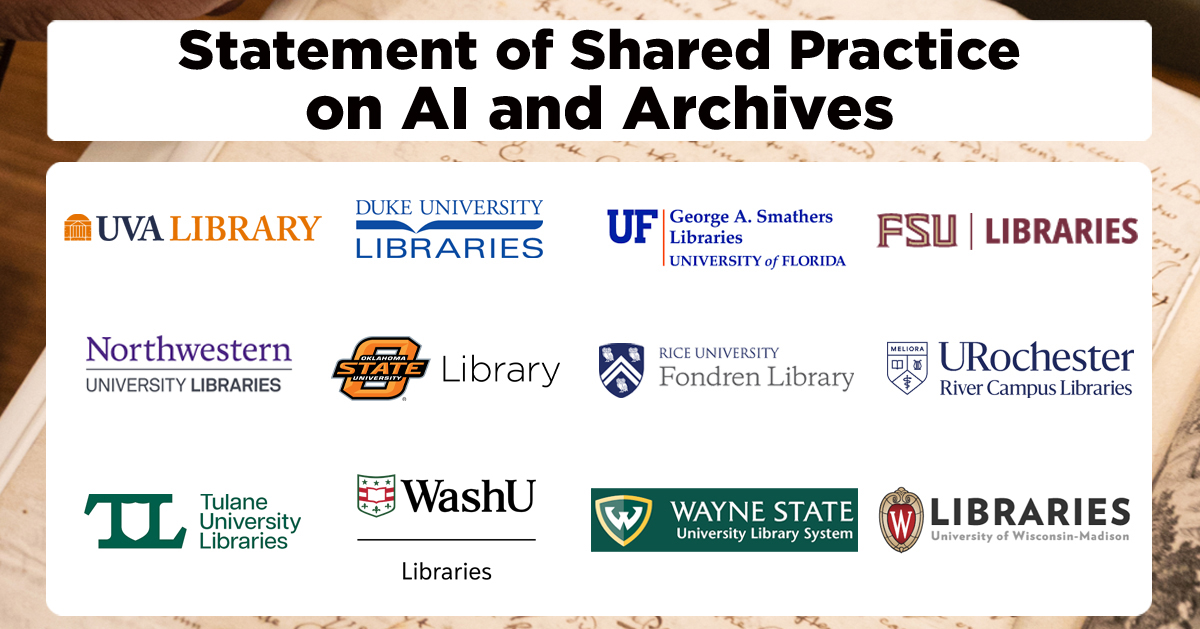
A Community-Driven Network
The Shared Practice was developed following an Association of Research Libraries (ARL) peer-to-peer session attended by representatives from more than 42 institutions. It was carefully refined based on feedback from a founding cohort, institutional counsel, and colleagues across the profession.
The founding cohort of signatories includes:
- University of Virginia Library (Coordinating Institution)
- Duke University Libraries
- Florida State University Libraries
- Northwestern University Libraries
- Oklahoma State University Library
- Rice University, Fondren Library
- Tulane University Libraries
- University of Florida, George A. Smathers Libraries
- University of Rochester, River Campus Libraries
- University of Wisconsin-Madison Libraries
- Washington University in St. Louis Libraries
- Wayne State University Libraries
Endorsement of the Shared Practice is open to any institution that stewards unique cultural collections — academic and public libraries, national archives, and museums. “We welcome memory institutions of all kinds to sign on, as we work together to proactively shape the future of archives,” Lo said.
Scope
The Shared Practice is a voluntary, 12-month commitment beginning April 3, 2026. It specifically focuses on archival and special collections and does not cover widely held published works. While it establishes rigorous standards, it is not a moratorium on AI; each institution retains full independent authority over its own access decisions. The Statement addresses how institutions evaluate new uses of entrusted materials, a question of disposition rather than access.
A key element of Shared Practice is the community. Signatories to the Statement of Shared Practice will have access to a shared, anonymized ledger of AI training requests participating institutions are receiving, along with general terms, giving insight into how peers are approaching similar requests.
Protecting Provenance and Donor Trust
Libraries and archives steward materials that often exist nowhere else — items entrusted to them by donors and communities for long-term preservation. A primary concern of the founding cohort is that current AI training methods “absorb” these materials into their systems irreversibly. This process severs the provenance connecting knowledge to its origins, making it impossible to trace which specific archival materials informed an AI’s response.
“Libraries hold materials that exist nowhere else,” Lo said. “When a company asks to use those materials to train an AI system, we owe it to the people who entrusted them to us to ask hard questions before saying yes.”
The Shared Practice is built on the UVA Archival AI Protocol, UVA Library’s institutional framework for evaluating AI training requests. The Shared Practice translates the Protocol’s principles into a collective commitment any institution can endorse.
The Six Shared Commitments
Participating institutions agree to commit to six shared principles when evaluating new AI training requests:
- Shared Definitions: Classify requests as retrieval, fine-tuning, general model training, or evaluation to ensure developers maintain clear boundaries.
- Separate Digitization from AI Use: Evaluate digitization funding and AI training rights as distinct agreements with independent terms.
- Require Provenance and Transparency: Determine if a proposed system can maintain traceable connections to source materials and if materials can be removed.
- Prefer Retrieval-Based Approaches: Favor methods where source materials remain under institutional control.
- Apply Heightened Scrutiny to Broad Training: Maintain a presumption against broad commercial training where meaningful control and provenance are not realistic.
- Share Information: Contribute to a confidential shared ledger to track request types and general terms, helping the profession move away from siloed decision-making.
Available Resources
The full text of the Shared Practice is available on the UVA Library website. Endorsement requires the signature of an institution’s senior leader (dean, director, university librarian, state archivist, or equivalent). Institutions may join at any time during the 12-month period. Withdrawal is permitted at any time by written notice.
The UVA Archival AI Protocol and its adoption guide and implementation toolkit are available as open implementation resources under CC BY 4.0 for any institution to adapt.
Leo Lo’s essay, “Memory Without Origin: Why Research Libraries and Archives Need Governance Infrastructure for the AI Training Era,” presents the rationale for the development of the UVA Archival AI Protocol.
For more information, contact Elyse Girard, Executive Director of Assessment, Communications & User Experience, at erg5q@virginia.edu.